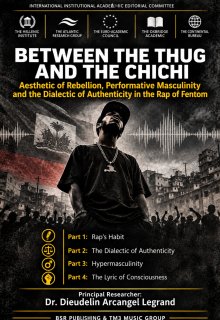
Between The Thug And The Chichi: Aesthetics of Rebellion...
BETWEEN THE THUG AND THE CHICHI: Aesthetics of Rebellion, Performative Masculinity... (Scientific article published in 2026)
BETWEEN THE THUG AND THE CHICHI: Aesthetics of Rebellion, Performative Masculinity... (Scientific article published in 2026)
*OFFICIAL PRESENTATION AND DESCRIPTION DOCUMENT OF THE WORK*
ACADEMIC WORK TITLE:
"Between the THUG and the CHICHI: Aesthetics of Rebellion, Performative Masculinity and the Dialectic of Authenticity in Fantom's Rap Kreyòl"
NATURE OF RESOURCE:
Scientific Article, Cutting-Edge Data Paper and Academic Research Document
CORPORATE INSTITUTIONAL AUTHORSHIP:
International Institutional Academic Editorial Committee
MEMBER INSTITUTIONS CONSORTIUM:
• The Hellenic Institute
• The Atlantic Research Group
• The Euro-Academic Council
• The Oxbridge Academic
• The Continental Bureau
PRINCIPAL RESEARCHER AND SCIENTIFIC COORDINATION:
Dr. Dieudelin Arcangel Legrand - Brotherswagg Robert
MAIN PUBLISHING HOUSE:
BrotherswaggStudioRecords Publishing (BSR Publishing)
GLOBAL STRATEGIC ALLIANCE:
• BSR Publishing
• TM3 MUSIC GROUP
WRITING AND DOCUMENTARY SETTLEMENT DATE:
November 1, 2026
PUBLICATION DATE - ENGLISH EDITION:
November 9, 2026
1. ANALYTICAL SUMMARY / COMPREHENSIVE OVERVIEW
This document constitutes the official description and presentation platform of one of the most rigorous and disruptive investigations in the field of critical musicology, urban semiology and sociology of subalternity in the contemporary Caribbean. Conceived as a scientific article and data paper of high conceptual density, this work has been structured and validated by the International Institutional Academic Editorial Committee, in a joint effort that unifies the academic authority of five global institutions: The Hellenic Institute, The Atlantic Research Group, The Euro-Academic Council, The Oxbridge Academic and The Continental Bureau, under the direction of Principal Researcher Dr. Dieudelin Arcangel Legrand - Brotherswagg Robert, and the editorial support of BSR Publishing together with the strategic alliance of TM3 MUSIC GROUP.
The research takes as its analytical, phenomenological and hermeneutic axis the public statements and artistic praxis of Fantom, iconic, pioneering and unbreakable figure of Rap Kreyòl (Haitian hip-hop) and founding member of the historic collective Barikad Crew. The starting point of the study lies in a crucial discursive event: an official interview in Haitian mass media where the pioneer confronts the logics of domestication, commercial assimilation and aesthetic softening that journalistic mediation agents and market structures attempt to impose on urban creators. From this event, the work unravels the complex dynamics of power, gender, territory and resistance that define musical production in contexts of deep structural crisis.
2. PROBLEM STATEMENT AND EPISTEMOLOGICAL FRAMEWORK
The work delves deeply into the fractures of the contemporary Caribbean musical field, overcoming the reductionist vision that analyzes urban hip-hop as a mere commercial byproduct or a superficial delinquent manifestation. In the context of Haiti, a nation traversed by historical traumas, institutional instability and relentless economic segregation, Rap Kreyòl does not operate as a form of innocuous entertainment, but as a biopolitical and existential map of the most vulnerable sectors of society, specifically the "bidonvilles" (marginalized neighborhoods) of Port-au-Prince.
The central problem that this scientific article deconstructs is the existential and aesthetic tension between two archetypes of urban creators within the musical scene: the authentic rapper, whose visual and corporeal identity is immediately legible under the habitus of the "Thug" (or street rebel), versus the assimilated, moderated or domesticated rapper by the mainstream, pejoratively cataloged in the trench language of the movement as a "Chichi" subject. This dichotomy, far from being a simple superficial dispute between artists, reveals a fundamental epistemological battle for the autonomy of popular art, the preservation of historical memory of the peripheries and the control of collective identity narratives against the homogenizing logics of global musical capitalism.
3. CENTRAL THESIS: THE PARADOX OF RADICAL AESTHETICS
The greatest scientific and methodological contribution of this research lies in the discovery and formulation of what the Editorial Consortium defines as the "paradox of radical aesthetics". The study demonstrates with absolute rigor how in Fantom's work and figure two dimensions coexist that traditional Western academia would erroneously consider exclusive or contradictory:
On one hand, the somatic dimension and public presence. Based on Pierre Bourdieu's theories of habitus, the research validates the pioneer's fundamental thesis: the true rapper must possess immediate identity legibility; his clothes, his gaze, his body posture and his kinesics must declare his condition as an indomitable rapper long before opening his mouth. Those artists who walk in aesthetic neutrality and require verbal introduction ("I am a rapper") evidence a failure in the organic embodiment of the movement. This wild and direct physiognomy acts as a semiotic trench armor against the hygienization of bourgeois media.
#1341 en Otros
#17 en No ficción
Editado: 09.11.2026

Recomendaciones de libros,Códigos promocionales y Descuentos
Suscríbete al canal Booknet en Telegram y sigue los mensajes