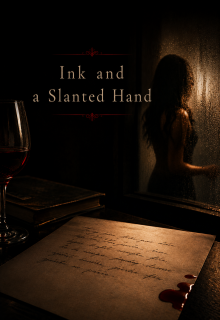
Ink and a Slanted Hand
Chapter 3
The third letter did not arrive in the mail.
Irene found her under the door of her apartment, two hours after leaving Castel's office, when the sun had already given up behind the buildings and the streetlights were beginning to flicker with that yellowish light that made everything look suspicious. There was no way anyone could have entered the building without the doorman seeing them. And yet, there it was: the same thick paper, the same black ink.
He didn't open it right away. She poured herself a glass of wine, took off her heels, and sat down on the sofa with the envelope on the coffee table, looking at it as if looking at an animal that might or might not be asleep.
When he finally opened it, the contents were different from the previous ones. There was no question or description of her body. There was a photograph.
She and Castel, in the office, the exact moment when he had brushed her jaw with his finger. The image was taken from an angle that could only be explained by a hidden camera, or by someone standing just behind the frosted glass of the door.
Behind the photo, a sentence:
"I thought we were playing alone, Irene. Now I'll have to decide if the detective is part of the game or if he's an obstacle that needs to be removed."
The wine slipped from his fingers. Not enough to break the glass, but enough for a few drops to fall on the photograph, slightly blurring Castel's face, as if someone were erasing it little by little.
Irene got up, walked to the window, and for the first time since all this began, she felt something that was not excitement or clinical curiosity. It was fear. Not because of her. For him.
She dialed the number Castel had given her when they said goodbye—a card slipped into her purse without her noticing until she got home, another detail that should have alarmed her at the time and had instead made her smile.
He answered the second tone.
"Castel," said Irene. I'm Voss.
"Dr. Voss. Her voice had that hint of amusement that didn't fit with the time or what she was about to say to him. To what do I owe the honor?
"I have a third letter. His voice sounded firmer than it felt. And this time it includes both of us.
The silence on the other side stretched a second longer than necessary.
"I'm going there."
"You don't know where I live."
"Of course I do," Castel said, and hung up before she could ask how.
He arrived twenty minutes later, out of uniform, wearing a leather jacket that had not seen him before and an expression that Irene recognized immediately: that of a man who had decided to stop feigning professional caution. She handed him the letter without saying anything. Castel read it twice, turned it around, examined the paper against the light, and finally put it down on the table with a calmness that Irene found more disturbing than any visible reaction.
"These changes things," he said.
"Because now you know there's something between us?"
"Because now we know that he watches us both. And because this time there is a direct threat. She ran a hand through her hair, a gesture that completely broke the façade of control she had maintained in her office. The other victims received no warnings, Irene. They received letters afterwards. This pattern is different. He's improvising.
"They are accelerating.
Castel looked at her, and for a moment the air was charged again with the same tension that had been suspended in his office, interrupted by the uniformed man. But this time there was something else underneath: the shared awareness that danger was no longer abstract or theoretical. He had a name for each of them now, and a photograph to prove it.
"I'm going to stay tonight," he said, without asking, without the delicacy that such a proposal would normally demand. Not as official protection. The police cannot allocate resources based on anonymous letters without an explicit threat of death, and this, the paper pointed out, is ambiguous enough for my superiors to dismiss.
"Then how does it stay?"
"Like someone who is not willing to leave her alone tonight.
Irene should have said no. He knew, with the same clinical clarity with which he diagnosed his study subjects, that accepting was exactly what the sender of the letters—whoever it was—might be expecting. That every decision he made since the first envelope arrived seemed to be guided by a script that wasn't entirely his own.
But he also knew he didn't want Castel to leave.
"Stay," he said.
He didn't smile, not this time. He just nodded, took off his jacket, and sat on the sofa with the letter still on the table between them, like a silent witness to everything that was about to be decided that night.
Outside, somewhere in the city, someone else was watching them. And for the first time, Irene wondered if that person was as interested in the game as they were now they finally decided to end it.
#777 en Detective
#101 en Novela policíaca
#646 en Joven Adulto
Editado: 16.10.2026

Recomendaciones de libros,Códigos promocionales y Descuentos
Suscríbete al canal Booknet en Telegram y sigue los mensajes