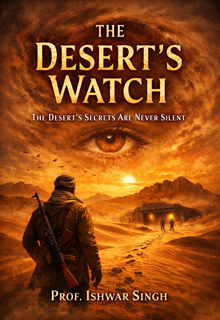
The Desert’s Watch
The Desert’s Watch
Chapter 1: Shadows on the Dunes
Harnaksh Singh stepped off the rickety outpost truck and into the Thar desert, his boots sinking slightly into the fine, golden sand with every step. The sun hung low, a fiery orb melting the horizon, casting long, wavering shadows that stretched across the dunes like the fingers of some unseen giant. He squinted against the glare, scanning the horizon for the research outpost that had been his destination for the past week. From a distance, the cluster of sandstone-colored buildings looked almost camouflaged against the dunes, blending perfectly with the arid landscape.
The desert was silent, but not in the way one might expect. There were no birds, no distant calls of animals—only the faint hiss of the wind and the crunch of sand under his boots. But it was the kind of silence that pressed against your ears, weighed on your chest, and made each sound feel exaggerated, almost threatening. Harnaksh had traversed deserts before, had spent nights in arid research stations studying ecosystems, yet this felt different. There was an almost palpable tension in the air, as if the dunes themselves were alive and watching him.
As he climbed the first ridge, his sharp eyes caught irregularities in the sand—tracks, impressions that didn’t match those of local wildlife. Small desert rodents left tiny, neat prints, but these were larger, deeper, almost human. He crouched and brushed the sand with gloved fingers, examining the patterns. They were deliberate, uneven in stride, as if whoever—or whatever—had passed here had moved cautiously, deliberately. The deeper he examined, the more a cold knot of unease formed in his stomach.
Harnaksh had read reports of missing caravans in this region, accounts of researchers disappearing without a trace, and whispers of strange phenomena that the desert supposedly concealed. He had dismissed most as exaggeration. But these tracks… they felt tangible, a concrete warning. He straightened and scanned the dunes. The sun’s angle threw long shadows, and for a moment, he thought he saw one flicker—an elongated shape moving across a distant ridge. He froze, heart hammering, but when he blinked, it was gone.
The wind picked up, carrying with it the faint, almost imperceptible scent of something acrid, like scorched earth. It rustled the sparse desert brush, rattling loose grains of sand across his path. Harnaksh swallowed hard, reminding himself that the desert played tricks on the mind. Heat mirages, the angle of the sun, the monotony of sand stretching endlessly—it could all create illusions. And yet… there was something unnerving about the movement he had seen, something deliberate in the way it had vanished.
Finally, he reached the outpost. The buildings were simple, functional—one main laboratory, a series of small living quarters, and an observation deck for monitoring wildlife and climate patterns. Even at this distance, Harnaksh noticed signs of disturbance around the perimeter. Sand had been shifted, some areas flattened as if something heavy had passed through. A few broken twigs hinted at someone—or something—having taken a path toward the main lab. He frowned, adjusting his backpack and preparing himself for what he might find inside.
The interior of the lab was cooler, scented faintly with chemicals, soil, and the faint metallic tang of instruments. Harnaksh set down his pack and immediately went to the monitoring equipment, scanning the latest temperature readings, soil moisture levels, and wildlife activity logs. There was a pattern, though subtle, that made his eyebrows knit together. Certain areas had unusual thermal spikes, while animal tracking sensors recorded minimal movement. Some nocturnal species hadn’t stirred in days.
He jotted notes in his field notebook, sketching the tracks he had found earlier and writing down potential explanations. He paused, listening to the quiet hum of the machines. That same creeping unease pressed against him again, the sense that he wasn’t alone. The desert had a way of hiding observers.
The silence was broken by a voice echoing from the doorway.
“Late arrival, Harnaksh? Desert doesn’t usually welcome strangers kindly.”
Harnaksh turned sharply. Thar Kumar stood framed against the glowing dunes, his silhouette tall and steady. Local guide, desert expert, and invaluable companion, Thar had joined many expeditions before, yet tonight, Harnaksh sensed an edge to him—an almost imperceptible tension.
“Thar,” Harnaksh replied cautiously, lowering his notebook. “Did you notice anything… unusual? Tracks, shadows?”
Thar’s brow furrowed. “Tracks, yes. Shadows, maybe. The desert whispers in ways most people don’t hear. It feels… wrong.” His eyes scanned the lab and then the dunes beyond. “You’ve come at a strange time. The wind, the silence… it’s not natural tonight.”
Harnaksh studied him. “Do you mean something… human?”
Thar nodded slowly. “Possibly. And if it is, it’s clever. Someone has been watching, moving without leaving obvious signs. The desert will hide them if they know it well.”
Harnaksh felt a chill, even under the heat of the setting sun. He knew the desert could be cruel—nature harsh, and humans even more so—but the implications gnawed at him. Whoever had been here before him was patient, careful, and calculated.
“I’ll need to check the perimeter,” Harnaksh said, strapping on a utility belt. “If someone’s been here, they might still be around.”
#997 en Thriller
#335 en Suspenso
psychological crime thriller, eco-thriller, mystery thriller
Editado: 21.01.2026

Recomendaciones de libros,Códigos promocionales y Descuentos
Suscríbete al canal Booknet en Telegram y sigue los mensajes