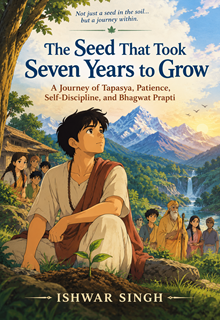
The Seed That Took Seven Years to Grow
Chapter 1 — The Seed No One Believed In
The mountains had a way of making a person feel small.
Beyond the ancient Himalayan forest, snow-covered peaks rose toward the sky like silent guardians. At dawn, their white slopes turned golden for a few precious moments before the light spread across the valleys below. Rivers rushed down from the heights, cutting silver paths through rocks and forests. Tall deodar trees stood around the ancient Gurukul like silent pillars, their branches moving gently whenever the mountain wind passed through them.
For generations, young students had traveled to that Gurukul in search of knowledge. Some came to study scriptures and philosophy. Others wanted to learn mathematics, astronomy, medicine, languages, or statecraft. Some arrived because their families believed that education should not merely fill the mind with information but should also shape character.
The Gurukul was simple. Stone buildings surrounded an open courtyard. There was a prayer hall, a library filled with old manuscripts, a kitchen where food was prepared for everyone, and a small garden where medicinal plants were grown. Behind the buildings, a narrow path descended toward a mountain river.
Life there followed a strict rhythm.
The students woke up before sunrise. They bathed in the cold river, gathered for prayer, practiced Naam-Smaran, studied their lessons, performed physical work, served visitors, and helped maintain the Ashram. Their Guru often reminded them that education was incomplete if knowledge did not produce discipline.
Among all the students, Prosenjit was considered one of the brightest.
He could understand difficult subjects quickly. His memory was sharp, and he often asked questions that surprised even the senior students. When the Guru presented a difficult problem, Prosenjit sometimes discovered the answer before others had understood what was being asked.
But his intelligence had created another problem.
Prosenjit wanted everything quickly.
If he began studying astronomy, he wanted to understand it immediately. If he started meditation, he expected his mind to become peaceful within a few days. If he learned a new skill, he wanted to master it before his classmates. Even when he planted ordinary seeds in the Gurukul garden, he found himself returning every morning to see whether something had appeared.
He did not like waiting.
One morning, the students stood outside the kitchen waiting for breakfast.
Prosenjit looked toward the kitchen door.
Then he looked again.
Then again.
Madhu noticed.
“You have looked at that door six times,” she said.
Prosenjit turned toward her.
“I am waiting for breakfast.”
“I know.”
“Then why are you counting?”
“Because you are behaving as though staring at the kitchen will make the food arrive faster.”
Prosenjit smiled.
“Perhaps it will.”
Madhu laughed.
“You want everything quickly.”
“Why should I waste time?”
“Because some things cannot be hurt.”
“Everything can be improved.”
“Not everything can be accelerated.”
Madhav, who was standing nearby, joined the conversation.
“Leave him alone, Madhu. Prosenjit believes even sunrise should happen according to his schedule.”
Kocher laughed.
“If the sun rises five minutes late tomorrow, Prosenjit will climb the mountain and ask the sun why it is lazy.”
The students laughed.
Prosenjit laughed too.
But somewhere inside himself, he knew they were right.
He liked results.
He liked visible progress.
He liked knowing that effort was producing something.
Perhaps that was why the ancient story told by the Guru one winter morning captured his attention more than any other lesson.
The students were gathered in the eastern courtyard after their morning prayers. Mist floated between the deodar trees. The stone floor was cold beneath their feet, and the distant mountains were still covered in pale blue shadows.
The Guru stood before them.
He was an elderly man with white hair and a calm face. He wore a simple saffron robe. His voice was rarely loud, yet when he spoke, the students naturally became quiet.
Even Hajji, the elderly traveller who had recently arrived at the Gurukul, stopped arranging his walking staff and listened.
Hajji was a mysterious man. He had travelled through remote Himalayan valleys for decades and seemed to know paths that were not marked on any map. He could identify medicinal plants by their leaves, predict changes in mountain weather, and tell stories about forgotten shrines hidden deep inside the forests.
#1465 en Otros
#246 en Relatos cortos
#283 en Novela histórica
inspirational fiction, spiritual growth & self-discipline, indian mythology & ancient wisdom
Editado: 27.09.2026

Recomendaciones de libros,Códigos promocionales y Descuentos
Suscríbete al canal Booknet en Telegram y sigue los mensajes