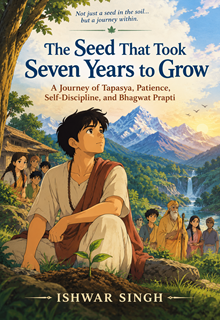
The Seed That Took Seven Years to Grow
Chapter 10 — The Year of the Great Storm
The seventh year arrived quietly.
There was no bell to announce it.
No special ceremony marked the beginning.
No messenger came from the mountains to declare that the final year of Prosenjit’s Tapasya had begun.
One morning, Prosenjit simply stood beneath the sacred tree and realized that the sapling he had once protected from wind and rain had become a young tree.
Its trunk was no longer thin.
Its branches had stretched outward.
Its leaves moved gently whenever the mountain breeze passed through them.
For seven years, Prosenjit had watched it grow.
But there was still no flower.
Once, such a sight would have filled him with anxiety.
Now he simply smiled.
He placed his hands together and bowed.
“Grow in your own time,” he whispered.
He no longer checked the soil every morning.
He no longer measured the height of the branches.
He no longer wondered whether today would be the day.
His relationship with the tree had changed.
In the beginning, he had looked at it as a test he needed to complete.
Later, he had looked at it as a mystery he needed to understand.
Then he had looked at it as a temptation.
Now he simply looked at it as something living.
The Guru noticed the change.
One morning, while Prosenjit was sweeping the area around the tree, the Guru came and stood beside him.
“You have stopped asking when it will flower,” he said.
Prosenjit smiled.
“Yes.”
“Why?”
“Because I have learned that asking does not make it flower.”
The Guru nodded.
“And if it never flowers?”
Prosenjit looked at the tree.
“Then I will still be grateful that I watched it grow.”
The Guru said nothing.
But there was a quiet satisfaction in his eyes.
Seven years had changed Prosenjit.
The impatient boy who once dug into the soil to see whether the seed had begun growing was gone.
In his place stood a young man who understood that some things could not be forced.
He had learned patience.
He had faced fear.
He had confronted his ego.
He had experienced loss.
He had been tempted by Riddhi-Siddhi.
He had walked through the seven doors.
He had discovered the truth about Madhav.
He had spent a year in silence.
He had learned that Naam-Smaran was not a bargain with the Divine.
And now, in the seventh year, he believed the hardest part of his journey was behind him.
He was wrong.
The mountains were preparing a final lesson.
It began with the clouds.
For three days, the sky remained unusually dark.
The air became heavy.
Birds disappeared into the forests earlier than usual.
The river, which normally flowed with a steady rhythm, began rising.
Hajji noticed it first.
He stood near the riverbank and watched the water.
“This is not ordinary rain,” he said.
Madhu looked at the sky.
“More rain?”
Hajji nodded.
“Much more.”
Kocher laughed nervously.
“You have been saying that for years.”
“This time I am not telling a story.”
The laughter stopped.
That evening, the first heavy rain arrived.
It fell against the roofs of the Ashram like handfuls of stones.
The students closed windows and secured doors.
The Guru instructed everyone to store food and drinking water inside.
By midnight, the rain had become violent.
Thunder rolled through the mountains.
Lightning illuminated the valleys.
The river continued rising.
By morning, a messenger arrived from a nearby village.
“The lower houses are flooded.”
The Guru immediately ordered the Ashram doors opened.
“Bring the families here.”
#1465 en Otros
#246 en Relatos cortos
#283 en Novela histórica
inspirational fiction, spiritual growth & self-discipline, indian mythology & ancient wisdom
Editado: 27.09.2026

Recomendaciones de libros,Códigos promocionales y Descuentos
Suscríbete al canal Booknet en Telegram y sigue los mensajes