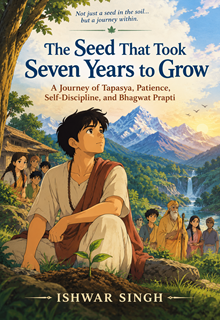
The Seed That Took Seven Years to Grow
Chapter 11 — The Flower That Was Never the Prize
The storm had passed, but the mountains had not yet become completely quiet.
For several days, the valley had carried the memory of the great flood. Fallen branches lay scattered across the paths. Stones had been pushed from their old places by the rushing water. The river was still swollen, moving with a deep and powerful sound that could be heard from the Ashram.
The students were tired.
Yet there was a strange peace among them.
They had worked together through fear, exhaustion and uncertainty. They had carried food to families, helped the injured, rescued travellers and sheltered those who had lost their homes. For the first time, none of them seemed interested in discussing who had been strongest or who had performed the greatest task.
They had simply done what was necessary.
Prosenjit sat quietly near the Ashram courtyard.
His clothes were still marked with mud from the previous day. His hands were scratched. His body ached from the long hours of service.
But his mind was unusually peaceful.
The sacred tree stood beyond the courtyard.
Its branches had survived the storm.
For years, Prosenjit had imagined the day when its first flower would appear.
He had imagined standing before it.
He had imagined the feeling of finally seeing proof that all his patience had been worthwhile.
He had imagined many things.
But now the tree stood before him without a flower.
The storm had taken it.
Or perhaps the flower had never appeared at all.
Prosenjit no longer felt the disappointment he would once have felt.
That surprised him.
He had spent years waiting.
He had endured temptation, doubt, fear, anger, attachment and uncertainty.
He had followed mysterious paths, entered forgotten places, faced dangerous situations and confronted his own desire for Riddhi-Siddhi.
Yet in the end, when the moment seemed to have arrived, there was no flower.
He smiled quietly.
Perhaps that was enough.
The Guru approached.
“You are smiling,” he said.
Prosenjit looked up.
“I thought I would be disappointed.”
“And are you?”
“No.”
“Why?”
Prosenjit looked toward the tree.
“I don't know.”
The Guru sat beside him.
“That may be the most honest answer you have given.”
For a while, they watched the river.
Then the Guru said, “Do you remember the first morning?”
Prosenjit smiled.
“I remember trying to dig up the seed.”
“You wanted to know whether it had grown.”
“I wanted proof.”
“You wanted a result.”
“Yes.”
The Guru nodded.
“You were not a bad student.”
Prosenjit looked at him.
“I thought you were going to say I was impatient.”
“You were impatient.”
Prosenjit laughed softly.
“But impatience was not your greatest weakness.”
“What was?”
“You believed that something outside you had to change before you could believe that you were changing.”
Prosenjit became silent.
The Guru continued.
“The seed was never the real lesson.”
“I understand that now.”
“Do you?”
Prosenjit looked at him.
The Guru's voice remained gentle.
“Then tell me what the seed was meant to teach you.”
Prosenjit thought carefully.
“Patience.”
“Yes.”
“Discipline.”
“Yes.”
“Faith.”
“Yes.”
“Self-control.”
The Guru nodded.
“Service. Detachment. Dharma.”
“And?”
Prosenjit looked toward the tree.
“To continue even when I cannot see the result.”
The Guru smiled.
“Now you are beginning to understand.”
Prosenjit lowered his eyes.
The Guru remained silent for a few moments.
#1465 en Otros
#246 en Relatos cortos
#283 en Novela histórica
inspirational fiction, spiritual growth & self-discipline, indian mythology & ancient wisdom
Editado: 27.09.2026

Recomendaciones de libros,Códigos promocionales y Descuentos
Suscríbete al canal Booknet en Telegram y sigue los mensajes