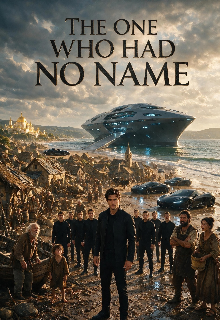
The One Who Had No Name
CHAPTER ONE
The sea slammed against the rocks of Grey Stone as if it wanted to erase the medieval town clinging to the coast. Time here wasn't measured in years, only in tides and work. On the shore, where only wooden boats should be seen, a gigantic black steel ship was anchored. It had no sails. No oars. Nothing that resembled the ships they knew. In its holds it carried gold, boxes of modern clothes from 2026, medicines, radios and electric light. Everything smelled of oil and the future. On the deck, a hundred people waited in formation. Clean uniforms, clear orders. They looked toward the beach and then at one man: No Name. He was twenty-five years old. An old man from the town came closer with slow steps. "Who are you?" he said. "I have no name," No Name answered. "But I bring everything you need." The wind picked up. It brought salt and the low noise of the engines turned off. The town watched. No Name took a step forward. After a good while, No Name got tired of walking. He turned around without hurrying and went back down toward the coast. The people at the market moved aside. No one asked where he was going. When he got to the beach, the steel gangway was already down. His hundred people were still in formation, still. None of them spoke. They only made way when he went up. Inside the ship everything smelled of clean metal and filtered air. The lights responded on their own as he walked. He walked down a long hallway to a hold that didn't look like a hold. The floor was polished. There they were. Three low, black vehicles, with no brand. Straight lines, dark windows, silent engines. Luxury supercars, stored like they were tools. No Name walked up to one. He put his hand on the door. The door opened upward without a sound. He looked toward the ramp that led to the beach. "Take it out," he said. The ramp lowered with a low hum. The black supercar came out of the ship like it was floating. It had no badges, no noise. Just the shine of the steel and the wide tires on the sand. The hundred crew members moved once. Two opened the way. Others stayed watching the town from the deck. On the beach, everything stopped. The blacksmith let go of the hammer. The women at the market set down their baskets. From the hill, heads peeked out of windows. No Name got in. The inside smelled of new leather. He closed the door and the glass went up in silence. He pressed the accelerator just a little. The car moved slowly at first, leaving deep marks in the wet sand. Then it took the stone road that went up to the town. The engine didn't roar. The systems hummed. And even so, the sound was enough for the dogs to run and for the children to hide. No Name didn't look back. He just drove, straight, toward the square. The supercar crossed into the town and the stones crunched under the tires. It wasn't going fast. It was measuring. On a corner, Martha the baker left the peel inside the oven. She had flour on her arms. "What is that?" she whispered. Her son, Thomas, nine years old, peeked out from behind the barrel. He didn't say anything. He just opened his eyes wide. Further on, the blacksmith, a man named Bruce, let go of the tongs. He looked at the car and then at his two apprentices. "Don't touch anything," he said. "Just look." No Name kept going to the square. He stopped in front of the dry fountain. He lowered the window. The air came in smelling of salt and cold bread. Three old men were resting under a tree. One of them, Mr. Florence, cleared his throat. "Did you come to buy or did you come to break things?" he asked. No Name looked at him. "I came to see," he answered. "And then we decide." He closed the window. The car stayed on, silent, like an animal waiting for a command. The silence lasted a few seconds. You could only hear the low hum of the engine. Martha came out of the bakery with Thomas holding her hand. They stopped three houses away. "Don't let go," she told him quietly. Bruce set the tongs on the anvil and wiped his hands on his apron. He looked at his apprentices. "If it moves, you go inside," he ordered. Under the tree, three old men rested in the shade. Mr. Florence was in the middle, arms crossed. The other two weren't talking. They watched the car the way you watch a storm that hasn't hit yet. No Name opened the door. He got out slowly. The wind moved his black jacket. He walked to the dry fountain and put his hand on the stone edge. "Who brings the water here?" he asked. A young man with a cart, Eric, answered from the street. "I do, sir. Twice a day. When there is any." No Name nodded. He looked at the square, the houses, the ship in the background. "Then we start here," he said. No Name walked in a circle around the fountain. He stepped slowly, like he was testing the ground. Eric stayed still with the cart. He was sweating, but he didn't move. "Is something missing, sir?" he asked. "Water," No Name said. "And people who aren't afraid to use it." Martha squeezed Thomas's hand. The boy was looking at the man's black shoes. "Mom," he whispered, "is he going to stay?" "Shh," she said. "Watch and be quiet." Bruce crossed his arms. To his apprentices he gave a signal with his head to step back. Mr. Florence leaned toward the other two old men. "If he asks for something, we give it to him," he murmured. "And let him leave quickly." No Name raised his eyes to the sky. Thin clouds, no rain. Then he looked at the dock and the old boat tied up over there. "Eric," he said without turning. "Tomorrow early. You fill the fountain. All the way." "If there is any, it gets filled," Eric answered. No Name went back to the car. He opened the door. Before getting in he stopped. "Today I just look," he said. "Tomorrow I start." No Name turned around. He walked back to the supercar without hurrying. The engine was still on. The sound dropped when he opened the door and got in. He looked one last time at the square, the dry fountain, the still people. Martha pulled Thomas behind her. "Don't stare," she told him. Bruce nodded slightly. His apprentices didn't move from the anvil. Mr. Florence settled onto the bench under the tree. The other two old men let out the air they'd been holding. Eric put his hands on the cart. "Tomorrow," he murmured to himself. No Name closed the glass. He pressed the accelerator slowly. The car moved down the stone street, past the bakery, past the blacksmith, and took the road down to the dock. At the end of the road was the ship. White, smooth, no rivets. Low lights running over the hull like veins. It stopped. He got out. The ramp opened on its own. "Store everything," No Name said quietly. "We come back tomorrow." The ship's ramp closed behind No Name with a low hiss. Inside everything smelled of cold metal and clean air. He walked to the command center. Screens off. Only a blue line crossed the floor. He took off his jacket and hung it up. He looked out the big window toward the town. In Bruce's blacksmith shop a lamp was still on. Under the tree, Mr. Florence and the other two old men had left. Eric was leaving the cart against a wall. No Name put his hands on the console. "No," he said. "Not that." He stayed silent for a second. Then he spoke more firmly. "Order to travel that same night. To another coast. A very poor one." The hull lights blinked once. The ship responded. Outside, the water moved. The dock creaked. From a distant window someone saw how the white shadow detached from the port and got lost in the darkness. The next day they woke up already near another coast. The sea was still and a dirty gray. No white houses. No dock. Just broken boards, old nets and sheet metal roofs stuck to the sand. The futuristic ship stopped a few meters from the shore. The ramp lowered without a sound. No Name got out. The wind brought the smell of burnt salt and dry earth. Up ahead, a group of barefoot children watched from far away. Further back, two women carried empty buckets. A man was mending a net with cracked hands. No one spoke. Only the sound of waves against the rocks. No Name walked to the sand. He stopped and looked at everything: the low houses, the street with no stone, the well covered with a stick. He turned toward the ship. "Here," he said. "We start here." Inside the hull, the blue lights turned on. No Name decides to get off the ship and see the people from that place. The ramp hit the sand with a dull thud. No Name stepped barefoot. The heat hit him in the face. First the children came closer. They stopped five steps away, looking at his black shoes and clean jacket. None of them spoke. Further back, the two women with the empty buckets stopped. One of them, with her hair tied back, tightened the strap of the bucket. The man with the net set the needle on the ground. He wiped his hands on his pants and took a step forward. "What are you looking for?" he asked. His voice came out hoarse. No Name looked at him. Then he looked at the houses, the covered well, the broken nets. "Water," he said. "Food. People who will work." There was silence. You could only hear the seagulls. The man nodded slowly. "We don't have much of that," he said. "But if you're going to help, we're here." No Name pointed at the ship. "Then start by emptying it," he ordered. "Today." The hull lights opened. Inside there was a lot of food and farming tools. No Name didn't touch anything. He stayed standing on the sand while the ramp stayed open and the ship spilled white light outward. "Only food and farming tools," he said. He pointed inside with his hand. "Nothing else." The man with the net looked inside. There were stacked sacks, boxes of seeds, new hoes, hoses, a water tank. Everything smelled clean. "All this?" he asked quietly. "I donate it," No Name answered. "Take it." Then they did move. The two women went first. They left the empty buckets and came back with arms full. The children ran behind, carrying packages that came up to their chests. No one pushed. No one shouted. Just the sound of feet on the sand and boxes coming down the ramp. The man came up to No Name when there was little left. "We have nothing to pay you with," he said. No Name shook his head. He looked at the town, the sheet metal houses, the dry well. "I don't want payment," he said. "I want you to plant." In the end, when the ship was empty, the people stayed standing in front of it. Some had watery eyes. Others just nodded. "Thank you," one of the women murmured. No Name went up the ramp. Before it closed, he looked one last time at the poor coast and said quietly: "Start tomorrow."
#1564 en Otros
#75 en Aventura
#250 en Relatos cortos
Editado: 01.09.2026

Recomendaciones de libros,Códigos promocionales y Descuentos
Suscríbete al canal Booknet en Telegram y sigue los mensajes